

Introduction
When people think of architectural drawings, they often imagine floor plans filled with measurements, walls, office spaces, desks, and other technical details. While these drawings are essential for planning a building, they do not always make it easy for clients and contractors to visualize the finished space.
Several years ago, while working as a Graphic and Web Designer for a company called Elgia, I was given an interesting challenge that showed me the true value of 3D visualization. What began as a standard office floor plan evolved into a visual communication tool that helped both the client and the painting team bring a design concept to life.
The Original Floor Plan
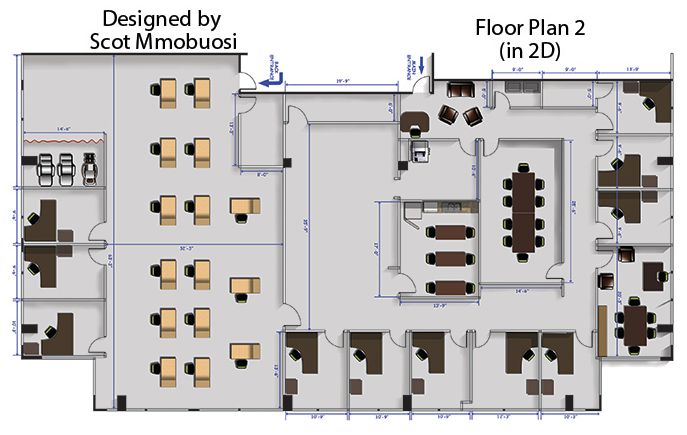
The project started with a traditional 2D floor plan that outlined the office layout, partitions, workspaces, and furniture placement. The drawing contained all the information needed for planning purposes, but it required technical interpretation to fully understand how the completed office environment would look.
For architects and designers, reading a floor plan is second nature. For many business owners and contractors, however, imagining the final appearance of a space from a flat drawing can be much more difficult.
A New Challenge
The owner wanted the office environment to be both professional and visually engaging. Different office spaces would feature different wall colors, creating a workplace that felt energetic while still maintaining a business atmosphere.
The challenge was not simply choosing colors. The owner needed a way to visualize how those colors would work together throughout the building before the painters began their work.
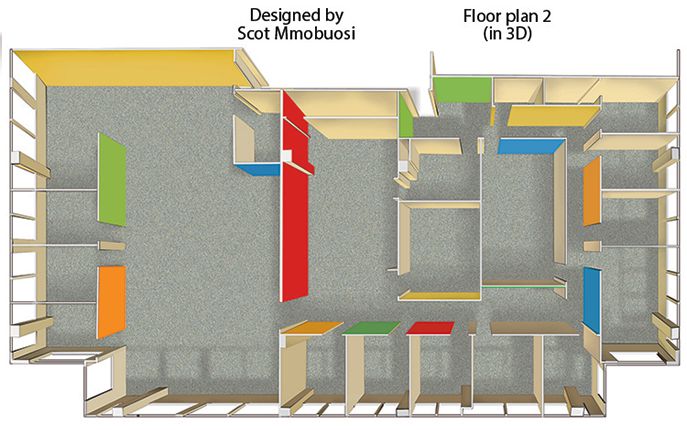
At that point, I was asked to create a roofless 3D visualization of the office layout. Instead of viewing the building as a flat plan, the client would be able to look down into the space and clearly see the individual office areas and wall partitions.
Bringing the Design to Life
Using the original floor plan as a foundation, I created a 3D projected view by extruding the walls upward while keeping the roof removed. This allowed the interior spaces to remain visible from above.
Once the structure was complete, I applied the selected colors to the various office partitions and work areas. Suddenly, the project was no longer a collection of lines on paper. The office had become something the client could actually visualize.
The owner was excited to see the concept take shape and was able to make color decisions with far greater confidence than would have been possible using the 2D plan alone.
Helping the Painting Team
One of the most rewarding parts of the project came after the visualization was completed.
Copies of the color-coded 3D projection were distributed to the painters responsible for the building’s interior finishes. Instead of relying solely on written instructions or interpreting technical drawings, each painter had a clear visual guide showing exactly where specific colors belonged.
The result was a smoother workflow and fewer opportunities for confusion. The painters could quickly identify each area and understand the intended design without constantly referring back to complex plans.
Several members of the painting team later expressed their appreciation for how much easier the visualization made their work. It is a compliment I have never forgotten.
Why 3D Visualization Matters
This experience reinforced an important lesson for me: good design is not just about creating drawings. It is about communication.
A well-prepared 3D visualization can help clients make informed decisions, improve collaboration between project teams, and reduce misunderstandings during implementation. Whether the project involves office design, renovations, commercial spaces, or residential developments, visual communication often bridges the gap between an idea and a successful outcome.
Final Thoughts
Traditional floor plans remain one of the most important tools in architecture and design. However, when combined with thoughtful 3D visualization, they become even more powerful.
In this project, a simple 3D representation helped transform a technical drawing into a practical communication tool that benefited the client, the designers, and the painters alike. It demonstrated how visualization can bring clarity to a project long before construction or finishing work is complete.
For me, it remains one of the most memorable examples of how design can make complex projects easier to understand and execute.
I genuinely think this is a strong first blog post for Scot Designs because it’s based on a real project, a real challenge, and a real outcome. Those kinds of stories tend to be far more compelling than generic articles because they showcase your experience while also teaching the reader something useful. 🚀🏗️🎨