
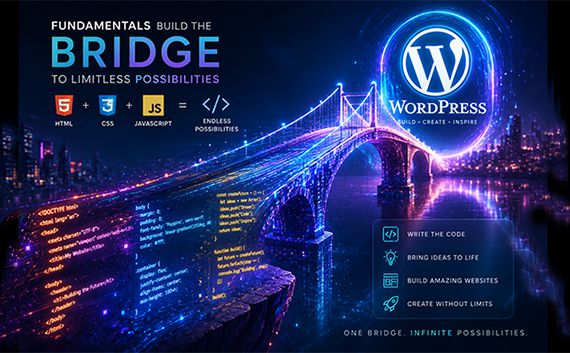
Introduction
Today, WordPress powers millions of websites around the world. With countless themes, plugins, page builders, and AI-powered design tools available, creating a website has never been easier.
But there was a time when I had never even opened the WordPress dashboard.
Ironically, that was the exact moment I was asked to build a company website.
Several years ago, while working as a graphic designer at a company called Elgia, our web development team had left the company. Almost overnight, I became one of the only people with any web-related experience.
There was just one problem.
I had never built a WordPress website before.
An Unexpected Challenge

At the time, I was comfortable writing HTML, CSS, and JavaScript. I had never built a website using Content Management Systems (CMS).
WordPress, was completely unfamiliar.
When I opened the WordPress dashboard for the first time, I honestly felt intimidated. The interface looked nothing like anything I had used before.
To make matters even more challenging, this was long before artificial intelligence, drag-and-drop website builders had become so advanced, or online tutorials were available at the click of a button.
The company needed a professional website quickly.
Learning WordPress from scratch simply wasn’t an option.
Falling Back on the Fundamentals
Instead of panicking, I decided to rely on something I already knew.
Rather than trying to learn every feature of WordPress overnight, I opened a simple text editor and began writing the website by hand using HTML, CSS, and JavaScript.
Every section…
Every layout…
Every responsive element…
Every line of code…
…was written manually.
Once the design was complete, I embedded the code into the WordPress page.
Then I held my breath.
It worked.
Not only did the website display correctly, but it was fully responsive and looked exactly as I had envisioned.
An Unexpected Compliment
When my boss saw the finished website, she asked a question that made me smile.
“Why didn’t you tell me you were a WordPress expert?”
I laughed and told her the truth.
“I’m not.”
What I did understand were the technologies behind every website:
- HTML
- CSS
- JavaScript
WordPress simply became the platform that displayed the work.
The Lesson That Changed My Career
That experience taught me something I have never forgotten.
Software changes.
Technology evolves.
New website builders appear every few years.
But the fundamentals remain.
Knowing how HTML structures a webpage…
Knowing how CSS controls its appearance…
Knowing how JavaScript adds interactivity…
Those skills never become obsolete.
They simply adapt to whatever platform comes next.
Ironically, after successfully completing that project, I finally had time to learn WordPress properly.
When I did, I discovered just how powerful—and how much easier—it could make website development.
But because I already understood the fundamentals, learning WordPress became much easier than I had expected.
Why Every Designer Should Learn to Code
I often meet designers who rely entirely on page builders or content management systems.
There’s nothing wrong with using those tools.
In fact, I use them myself.
However, I believe every web designer benefits from understanding at least the basics of HTML, CSS, and JavaScript.
When you know what’s happening behind the scenes, you’re no longer limited by the features of a particular platform.
Instead of asking,
“Can WordPress do this?”
you begin asking,
“How can I build this?”
That shift in thinking opens up endless creative possibilities.
Final Thoughts

Looking back, I’m grateful that I didn’t let my lack of WordPress experience stop me.
What seemed like an impossible assignment became one of the most valuable learning experiences of my career.
It reminded me that confidence doesn’t always come from knowing every piece of software.
Sometimes it comes from trusting the fundamentals you’ve already learned.
Technology will continue to change.
New frameworks, content management systems, and AI-powered tools will continue to appear.
But solid design principles and a strong understanding of code will always provide a foundation you can build upon.
For me, that unexpected WordPress project wasn’t just the beginning of learning a new platform.
It was a reminder that the strongest tools any designer can possess are curiosity, adaptability, and a willingness to keep learning.